
Beastiversity · Sister to LinguaBeasts · The Workshop
MathBeasts
The same idea as LinguaBeasts, for college math. These aren't villains — they're persistent little error-habits with personalities. Spot the beast, figure out its trick, fix the work and, with practice, tame it for good.
- STEP 1Spot the beast
- STEP 2Understand its trick
- STEP 3Fix the problem
- STEP 4Check the result
- STEP 5Tame the beast
Workshop pathways
Gateway course paths
Foundation Beasts show up when you need a prerequisite skill inside your college course — you fix it right there, instead of being sent through a separate remedial sequence.
Shared layer
Foundation Beasts
Prerequisite skills that appear across every path below.
Initial focus
Math & Society Beasts
Quantitative reasoning for voting, finance, risk and everyday decisions.
● In development
Statistics Beasts
Data, distributions, probability and inference.
● In development
College Algebra Beasts
Functions, equations, graphs and modeling.
● In development
Coming later
Finite Math
Matrices, linear programming, counting and probability.
Applied Math
Math for business, health and technical programs.
Precalculus / Calculus
Trigonometry, limits, rates of change and beyond.
Beast Bench · All Topics
MathBeast Catalog
39 error-habits across 5 families. 4 have playable challenges; the rest are catalog entries with challenges in development. Track tags are proposed support mappings, not any institution's course requirements.
Showing 39 of 39
Foundations
Number sense every college course leans on.
- WHOLE NUMBERS & PLACE VALUEDESIGNED ICON
Place-Value Pip
Lines numbers up by their left-hand digits instead of by place value.
Principle & example
Align ones under ones, tens under tens (and decimal points under decimal points) before adding or subtracting.
✗ 305 + 42 = 725 (42 slid under the 30)
✓ 305 + 42 = 347
Prerequisites: counting, place-value
StatisticsQuantitative ReasoningCollege Algebra
● Challenge in development
- ESTIMATION & ROUNDINGPORTRAIT

Rounding Rogue
Rounds intermediate results, so the error compounds before the final answer.
Principle & example
Keep full precision through the working; round once, at the end, to the requested place.
✗ 2.46 × 3.46 → 2.5 × 3.5 = 8.75 ≈ 8.8
✓ 2.46 × 3.46 = 8.5116 ≈ 8.5
Prerequisites: place-value, decimals
StatisticsQuantitative ReasoningCollege Algebra
● Challenge in development
- SIGNED NUMBERSPORTRAIT

Sign-Switch Sam
Treats subtracting a negative as subtracting, and mis-signs products of negatives.
Principle & example
a − (−b) = a + b; same signs multiply or divide to a positive, different signs to a negative.
✗ −7 − (−3) = −10
✓ −7 − (−3) = −7 + 3 = −4
Prerequisites: number-line, integer-addition
StatisticsQuantitative ReasoningCollege Algebra
- FRACTIONSPORTRAIT

Denominator Danny
Adds the denominators when adding fractions with unlike denominators.
“Means well. They were both on the bottom, so he added them.”
Principle & example
Rewrite over a common denominator, then add numerators only.
✗ 1/3 + 1/4 = 2/7
✓ 4/12 + 3/12 = 7/12
Prerequisites: equivalent-fractions, multiples
StatisticsQuantitative ReasoningCollege Algebra
- DECIMALSPORTRAIT

Decimal Drift
Places the decimal point in a product by copying one factor's places.
“Dreamy and floaty; the decimal point wanders off when nobody's watching.”
Principle & example
A product has as many decimal places as the factors combined; estimate to confirm.
✗ 0.3 × 0.2 = 0.6
✓ 0.3 × 0.2 = 0.06
Prerequisites: place-value, multiplication
StatisticsQuantitative ReasoningCollege Algebra
● Challenge in development
- RATIOS & PROPORTIONSPORTRAIT
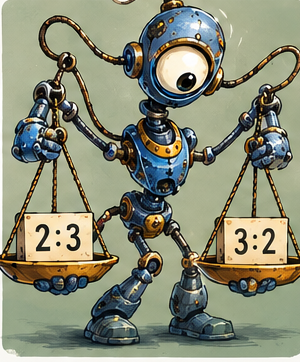
Ratio Ripper
Reverses which quantity each part of a ratio describes.
Principle & example
Keep the order: boys : girls = 3 : 2 means boys/girls = 3/2.
✗ Boys : girls = 3 : 2, 30 girls → 20 boys
✓ boys = (3/2) × 30 = 45
Prerequisites: fractions, multiplication
StatisticsQuantitative ReasoningCollege Algebra
● Challenge in development
- PERCENTAGESPORTRAIT
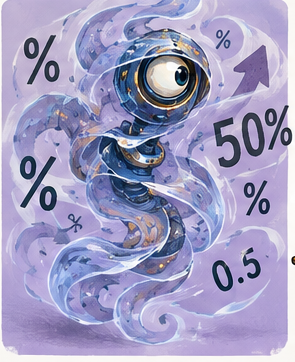
Percent Phantom
Converts a percent to a decimal by moving the point one place instead of two.
Principle & example
Percent means per hundred: 5% = 5/100 = 0.05.
✗ 5% of 80 = 0.5 × 80 = 40
✓ 5% of 80 = 0.05 × 80 = 4
Prerequisites: decimals, fractions
StatisticsQuantitative ReasoningCollege Algebra
● Challenge in development
- ORDER OF OPERATIONSPORTRAIT

Order-of-Ops Ollie
Works strictly left to right, ignoring grouping and operation precedence.
“A frazzled mechanic who always pulls the nearest lever first.”
Principle & example
Grouping, exponents, multiplication/division (left to right), then addition/subtraction (left to right).
✗ 8 + 3 × 4 = 44
✓ 8 + 3 × 4 = 8 + 12 = 20
Prerequisites: four-operations
StatisticsQuantitative ReasoningCollege Algebra
Algebra
Moving symbols without breaking the math.
- LIKE TERMSDESIGNED ICON
Like-Term Larry
Combines terms with different powers as if they were like terms.
Principle & example
Only terms with the same variable raised to the same power combine; add their coefficients.
✗ 3x + 2x² = 5x³
✓ 3x + 2x² is already simplified; 3x + 2x = 5x
Prerequisites: variables, exponents-basic
College AlgebraQuantitative Reasoning
● Challenge in development
- DISTRIBUTIONDESIGNED ICON
Distributor Dee
Multiplies only the first term inside the parentheses.
Principle & example
a(b + c) = ab + ac: the outside factor multiplies every term inside, sign included.
✗ 3(x + 4) = 3x + 4
✓ 3(x + 4) = 3x + 12
Prerequisites: signed-numbers, like-terms
College AlgebraQuantitative Reasoning
- EQUALITY & LINEAR EQUATIONSDESIGNED ICON
One-Side Wes
Applies an operation to only one side of an equation.
Principle & example
Whatever you do to one side, do to the other, so the equation stays true.
✗ 2x + 5 = 13 → 2x = 13 → x = 6.5
✓ 2x = 13 − 5 = 8 → x = 4
Prerequisites: inverse-operations, like-terms
College AlgebraQuantitative ReasoningStatistics
● Challenge in development
- INEQUALITIESDESIGNED ICON
Flip-Flop Fiona
Keeps the inequality direction after multiplying or dividing by a negative.
Principle & example
Multiplying or dividing both sides by a negative number reverses the inequality.
✗ −3x < 12 → x < −4
✓ −3x < 12 → x > −4
Prerequisites: signed-numbers, linear-equations
College AlgebraQuantitative Reasoning
● Challenge in development
- EXPONENTSDESIGNED ICON
Exponent Ezra
Adds exponents when raising a power to a power.
Principle & example
(xᵃ)ᵇ = xᵃᵇ — multiply the exponents; add them only when multiplying same-base powers.
✗ (x³)² = x⁵
✓ (x³)² = x³ · x³ = x⁶
Prerequisites: multiplication, exponents-basic
College AlgebraQuantitative Reasoning
● Challenge in development
- POLYNOMIALS & FACTORINGDESIGNED ICON
Binomial Bruno
Squares a sum term by term, dropping the middle term.
Principle & example
(a + b)² = a² + 2ab + b²; multiply every term by every term.
✗ (x + 3)² = x² + 9
✓ (x + 3)² = x² + 6x + 9
Prerequisites: distribution, like-terms
College Algebra
● Challenge in development
- RATIONAL EXPRESSIONSPORTRAIT
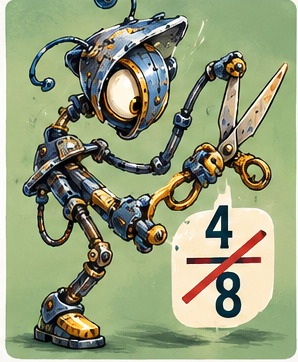
Canceling Carl
Cancels a term that is added, rather than a common factor.
Principle & example
Only common factors of the whole numerator and denominator cancel.
✗ (x + 6)/6 = x + 1
✓ (x + 6)/6 = x/6 + 1
Prerequisites: fractions, factoring
College Algebra
● Challenge in development
- RADICALSDESIGNED ICON
Root-Split Rhea
Splits a square root across a sum.
Principle & example
√(ab) = √a·√b for nonnegative a, b, but √(a + b) is not √a + √b.
✗ √(9 + 16) = 3 + 4 = 7
✓ √(9 + 16) = √25 = 5
Prerequisites: exponents-basic, order-of-operations
College AlgebraQuantitative Reasoning
● Challenge in development
Functions & Graphs
Reading and building relationships between quantities.
- COORDINATESDESIGNED ICON
Swap-Coord Cora
Plots (x, y) with the coordinates swapped.
Principle & example
The first coordinate is horizontal (x), the second vertical (y).
✗ (2, 5): 5 right, 2 up
✓ (2, 5): 2 right, 5 up
Prerequisites: number-line, signed-numbers
StatisticsQuantitative ReasoningCollege Algebra
● Challenge in development
- SLOPEDESIGNED ICON
Rise-Run Rudy
Computes slope as run over rise.
Principle & example
Slope = change in y ÷ change in x = (y₂ − y₁)/(x₂ − x₁).
✗ (1, 2), (3, 8): slope = 2/6 = 1/3
✓ slope = (8 − 2)/(3 − 1) = 3
Prerequisites: coordinates, fractions
StatisticsQuantitative ReasoningCollege Algebra
● Challenge in development
- INTERCEPTSDESIGNED ICON
Intercept Iggy
Finds the x-intercept by setting x = 0.
Principle & example
x-intercept: set y = 0. y-intercept: set x = 0.
✗ y = 2x − 6: x-intercept (0, −6)
✓ 0 = 2x − 6 → x = 3; x-intercept (3, 0)
Prerequisites: linear-equations, coordinates
College AlgebraQuantitative Reasoning
● Challenge in development
- FUNCTIONSDESIGNED ICON
Notation Ned
Reads f(x + 2) as f(x) + 2.
Principle & example
f(x + 2) means substitute x + 2 for every x in the rule.
✗ f(x) = x²: f(x + 2) = x² + 2
✓ f(x + 2) = (x + 2)² = x² + 4x + 4
Prerequisites: substitution, distribution
College Algebra
● Challenge in development
- SYSTEMS OF EQUATIONSDESIGNED ICON
Half-Solve Sully
Reports one variable's value as the whole solution of a system.
Principle & example
A solution to a system in two variables is an ordered pair that satisfies every equation.
✗ x + y = 10, x − y = 4 → x = 7. Done.
✓ x = 7, y = 3: solution (7, 3)
Prerequisites: linear-equations, substitution
College AlgebraQuantitative Reasoning
● Challenge in development
- QUADRATICSDESIGNED ICON
Root-Drop Quill
Keeps only the positive root when solving a squared equation.
Principle & example
x² = k (k > 0) has two solutions: x = ±√k.
✗ x² = 9 → x = 3
✓ x² = 9 → x = 3 or x = −3
Prerequisites: radicals, signed-numbers
College Algebra
● Challenge in development
- EXPONENTIAL GROWTHDESIGNED ICON
Linear Lyle
Treats a constant percent growth rate as adding a constant amount.
Principle & example
Growth of r% per period multiplies by (1 + r) each period: A = P(1 + r)ᵗ.
✗ 1,000 growing 10%/yr for 3 yrs: 1,000 + 3 × 100 = 1,300
✓ 1,000 × 1.1³ = 1,331
Prerequisites: percentages, exponents-basic
StatisticsQuantitative ReasoningCollege Algebra
● Challenge in development
- LOGARITHMSDESIGNED ICON
Log Lars
Treats the log of a sum as the sum of logs.
Principle & example
log(ab) = log a + log b, but log(a + b) has no such split.
✗ log(10 + 100) = 1 + 2 = 3
✓ log(110) ≈ 2.04; log(10 × 100) = 3
Prerequisites: exponents-basic, functions
College AlgebraQuantitative Reasoning
● Challenge in development
Quantitative Reasoning
Units, rates, money, shapes and sense-checking.
- UNITS & CONVERSIONSPORTRAIT

Unit Ursula
Combines measurements in different units without converting.
“Surrounded by rulers that don't agree, and happy to mix them.”
Principle & example
Convert to a common unit first, and carry units through every step.
✗ 2 m + 50 cm = 52
✓ 2 m + 0.5 m = 2.5 m
Prerequisites: decimals, multiplication
StatisticsQuantitative ReasoningCollege Algebra
● Challenge in development
- RATESDESIGNED ICON
Rate Reggie
Averages two speeds directly when the times differ.
Principle & example
Average speed = total distance ÷ total time.
✗ 60 mi at 30 mph, 60 mi back at 60 mph: (30 + 60)/2 = 45 mph
✓ 120 mi ÷ (2 h + 1 h) = 40 mph
Prerequisites: units, fractions
Quantitative ReasoningStatistics
● Challenge in development
- FINANCIAL MATHDESIGNED ICON
Rate-Period Petra
Applies an annual interest rate to a single monthly period.
Principle & example
Divide the annual rate by the number of compounding periods per year.
✗ $1,000 at 6%/yr compounded monthly, 1 month: $60 interest
✓ 1,000 × 0.06/12 = $5 interest
Prerequisites: percentages, decimals
Quantitative Reasoning
● Challenge in development
- PERCENT CHANGEDESIGNED ICON
Markdown Mort
Assumes a percent increase and the same percent decrease cancel.
Principle & example
Successive percent changes multiply, and each applies to a different base.
✗ $100 +20% then −20% → $100
✓ 100 × 1.2 × 0.8 = $96
Prerequisites: percentages
Quantitative ReasoningStatistics
● Challenge in development
- GEOMETRY & MEASUREMENTDESIGNED ICON
Area-Scale Archie
Thinks scaling lengths by k scales area by k.
Principle & example
Scaling lengths by k scales area by k² and volume by k³.
✗ Square side 3 → 6: area 9 → 18
✓ area 9 → 36 (× 2² = × 4)
Prerequisites: area, exponents-basic
Quantitative ReasoningCollege Algebra
● Challenge in development
- MODELINGDESIGNED ICON
Trendline Trixie
Extends a model far beyond the data it was built from.
Principle & example
A model is trustworthy only near the range of its data; check whether the trend can continue.
✗ Grew 6 cm/yr, 85 → 121 cm from age 2 to 8, so 121 + 32 × 6 = 313 cm at 40
✓ The linear model fits ages 2–8 only; growth stops, so don't extrapolate to 40
Prerequisites: slope, rates
Quantitative ReasoningStatistics
● Challenge in development
- REASONABLENESSPORTRAIT

Magnitude Max
Accepts an answer without noticing it is the wrong size.
Principle & example
Estimate first and compare: does the size of the answer make sense in context?
✗ 15% tip on $40 = $600
✓ 0.15 × 40 = $6 — a tip can't exceed the bill
Prerequisites: estimation, percentages
StatisticsQuantitative ReasoningCollege Algebra
● Challenge in development
Statistics & Probability
Reading data honestly and reasoning about chance.
- INTERPRETING GRAPHSDESIGNED ICON
Axis Axel
Reads bar heights on a truncated axis as proportional to the values.
Principle & example
Compare the values themselves; check where the axis starts.
✗ Bars 52 vs 48, axis from 46: bar 3× taller → 'three times as many'
✓ 52 ÷ 48 ≈ 1.08: about 8% more
Prerequisites: ratios, percentages
StatisticsQuantitative Reasoning
● Challenge in development
- CENTERDESIGNED ICON
Median Mabel
Takes the middle value of an unsorted list as the median.
Principle & example
Sort the data first; the median is the middle of the ordered list.
✗ 7, 2, 9, 4, 5 → median 9
✓ 2, 4, 5, 7, 9 → median 5
Prerequisites: ordering-numbers
StatisticsQuantitative Reasoning
● Challenge in development
- SPREADDESIGNED ICON
Spread Spencer
Thinks bigger values mean more spread.
Principle & example
Spread measures how far values sit from each other (range, IQR, SD), not how large they are.
✗ {98, 100, 102} is more spread than {1, 10, 19}
✓ Range 4 vs range 18: {1, 10, 19} is more spread
Prerequisites: center, signed-numbers
Statistics
● Challenge in development
- PROBABILITYDESIGNED ICON
Gambler Gus
Believes independent outcomes are 'due' after a streak.
Principle & example
For independent trials, past outcomes don't change the next probability.
✗ Fair coin, 5 heads in a row → tails now more likely than 1/2
✓ P(tails) is still 1/2
Prerequisites: fractions, probability-basic
StatisticsQuantitative Reasoning
● Challenge in development
- CONDITIONAL PROBABILITYDESIGNED ICON
Converse Connie
Treats P(A | B) as if it were P(B | A).
Principle & example
Conditional probabilities reverse only through the base rate (Bayes' rule).
✗ Test catches 90% of cases, so a positive means 90% chance of the condition
✓ With 1% prevalence and 9% false positives: 0.009 ÷ (0.009 + 0.0891) ≈ 9.2%
Prerequisites: percentages, probability-basic
StatisticsQuantitative Reasoning
● Challenge in development
- SAMPLING & BIASDESIGNED ICON
Volunteer Vera
Generalizes from a voluntary-response sample to a whole population.
Principle & example
Only a random (probability) sample supports generalizing to the population.
✗ 80% of 2,000 website poll respondents oppose → 80% of the town opposes
✓ Self-selected respondents aren't representative; a random sample is needed
Prerequisites: percentages
StatisticsQuantitative Reasoning
● Challenge in development
- ASSOCIATION & CAUSATIONDESIGNED ICON
Causal Cal
Concludes causation from an observed correlation.
Principle & example
Correlation alone doesn't show cause; look for lurking variables or a randomized experiment.
✗ Ice-cream sales and drownings correlate (r = 0.8), so ice cream causes drowning
✓ Summer heat drives both; the data show association, not cause
Prerequisites: interpreting-graphs
StatisticsQuantitative Reasoning
● Challenge in development
- STATISTICAL INFERENCEDESIGNED ICON
P-Value Penelope
Reads a p-value as the probability the null hypothesis is true.
Principle & example
A p-value is the probability of data at least this extreme, assuming the null is true.
✗ p = 0.03 → 3% chance the null is true
✓ If the null were true, results this extreme would occur about 3% of the time
Prerequisites: probability-basic, sampling
Statistics
● Challenge in development
Demo bench · Demonstration only
Tame one beast
A fixed sample of the loop. It doesn't check your own work, and it saves nothing.
1. Spot the beast — something's off
1/3 + 1/4 = 2/7